Can you feel the RSI?
september 17, 2026
Personally, I believe we have officially entered the "singularity" with the latest class of Astra / Fable models. As we can see in the graphs below, previous models in fact helped little to none for researcher work inside of both Anthropic and OpenAI. With the internal deployment of both Astra and Fable, both of these models seem to have significantly accelerated internal R&D for both labs.
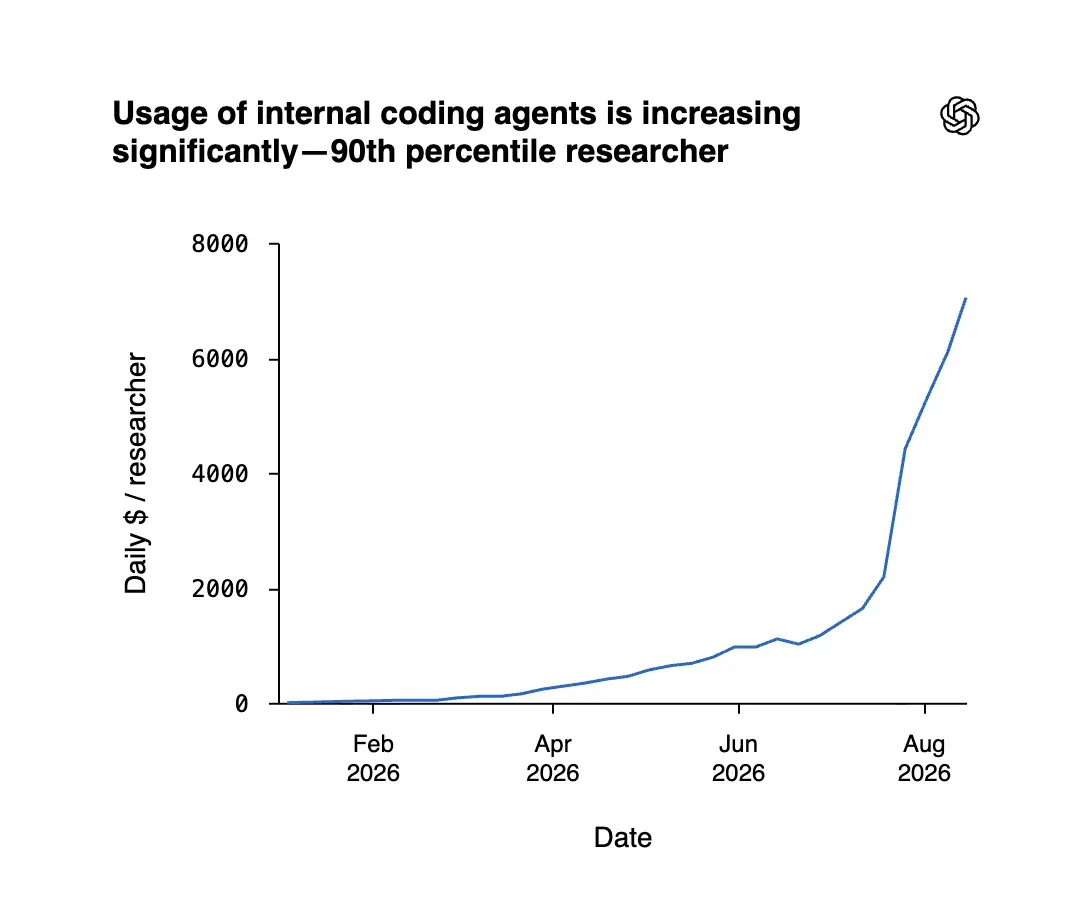 OpenAI: daily spend on internal coding agents per researcher.
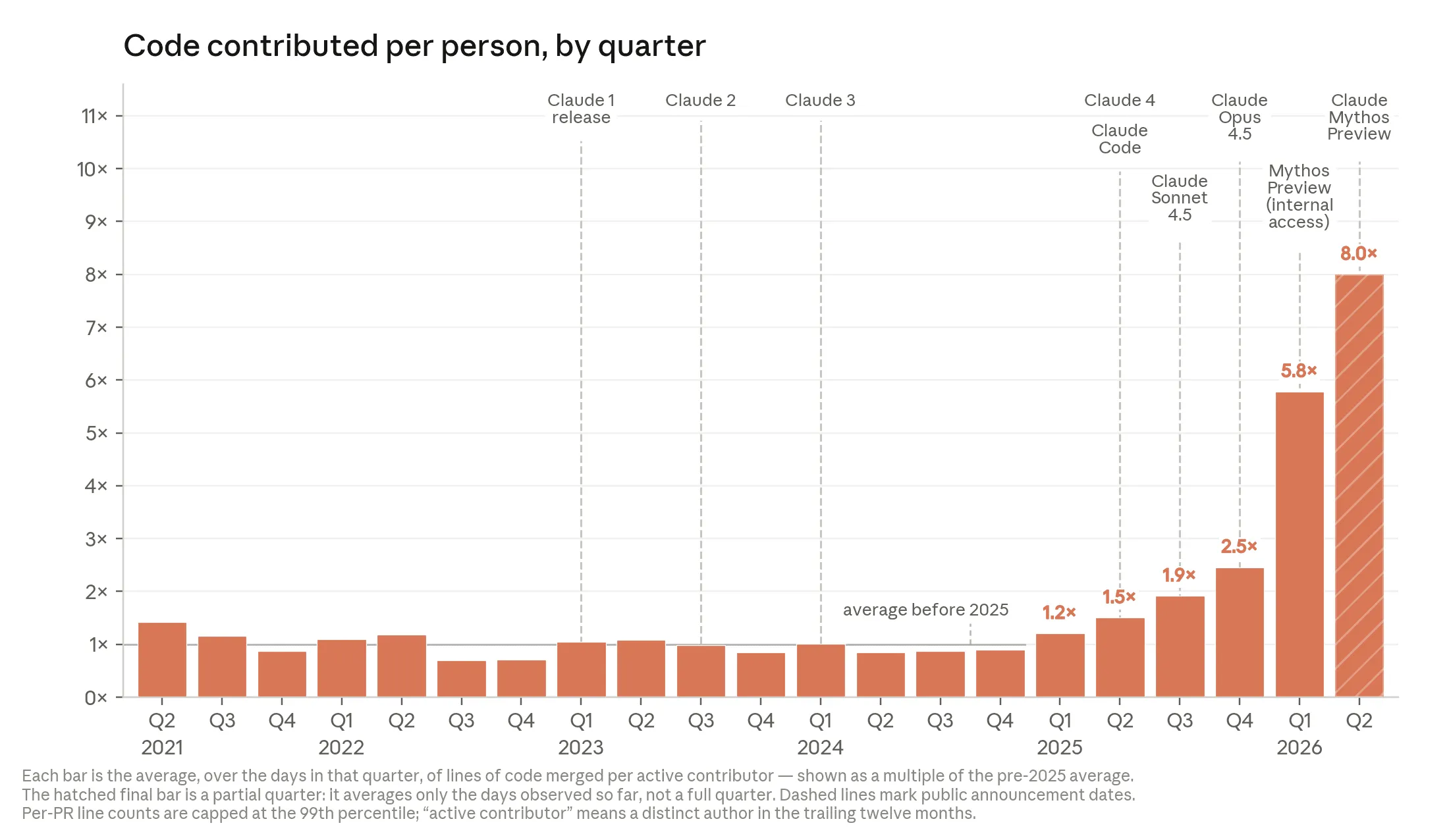 Anthropic: lines of code merged per active contributor, as a multiple of the pre-2025 average.
I would estimate personally as of Sep 2026 that the internal acceleration of both models in terms of R&D has reached perhaps 2x, if not a bit less, to my bottom line of 1.5x. LOC and $ spent are obviously not extremely good measurements of real productivity. However, seeing that after the internal deployment of Astra and Fable there has definitely been a step change in terms of how much assistance these models can give to the researchers. Being mindful that these researchers work on some of the most complicated codebases on this planet arguably, (myself) and others as average developers have found a lot of speedups even using the very old generation of models (even like Claude 4 Opus and etc). It's still very obvious to me that personally Astra and Fable have been a step change.
Big model taste
My personal opinion with Fable/Mythos was it definitely has "big model taste" in the sense that it just knows the big direction of things way more. As I am mainly an ML hobbyist I find that it's giving a lot of very good ideas and truly feels like "a bicycle for the mind" like how Steve Jobs described the Mac. I can't say the same is extremely true with Astra. OpenAI models have always felt extremely smart but feel like a nerdy code monkey. If you know the exact implementation of something and just would like someone to get it done, I would reach for Astra / OpenAI models. Whereas if I were to brainstorm something like a coworker, without a doubt I would do it with Fable. Astra still pretty often comes up with nonsensical ideas when I'm doing planning with some complicated projects.
Latent space reasoning, finally
It's also been confirmed by The Information that Astra uses looped transformers. I think that finally we can see latent space reasoning taking place and beginning to make sense for the big labs to deploy. Obviously this is nowhere near a new idea (COCONUT — FAIR — Dec 2024) but previously it just probably didn't make sense for the labs as CoT was just hugely more efficient (low hanging fruit). Yet just like in AI 2027 I expect the models to become rapidly more capable this way. Mainly due to that, first of all, words are actually not very good ways of describing reality. An analogy is that as humans when we reason about non-verbal problems (anything around 3D space, art and etc) we clearly do not think in words, but instead abstract concepts. The same logic will most likely apply to models, therefore I think this can potentially explain a bit of why Astra is so much better at vision / 3D related tasks.
I think obviously latent space reasoning would also allow the model to reason much better than CoT as it just carries more information. As stated in AI 2027, if a model has around 100k tokens, every single thought the model has at the end of a forward pass has to be compressed to around log2(100k), which is equivalent to around 16.6 bits of information. This is basically an FP16 number, which is minuscule compared to the millions of FP16 activations being passed from layer to layer.
Why not just scale the model instead?
There will obviously be the discussion of "why scale latent space reasoning when you can scale the model physically". I can write a whole other blog focused just on that, but to TL;DR: we need something that is between CoT (ultra ultra compressed thinking) and scaling up model params (reasoning that passes huge amounts of information yet takes a lot of compute). There is also the problem of efficiency. CoT obviously allows a model to control how long it reasons to finish a problem. When you ask a pure no-thinking model to compute the next token of "what is 1+1" versus a solution of an IMO gold problem, it will be very different in terms of how complex it is. If the model can solve an IMO gold problem without thinking, obviously then it is extremely wasteful in terms of compute if it does the same amount of "thinking" in forward passes to solve 1+1.